Making and Materials
Noble Fir and Mixed Evergreen Wreaths
Compare noble fir and mixed evergreen wreaths on needle, scent, colour, weight and price, and pick the bough mix that suits a door, a gift or a sale.
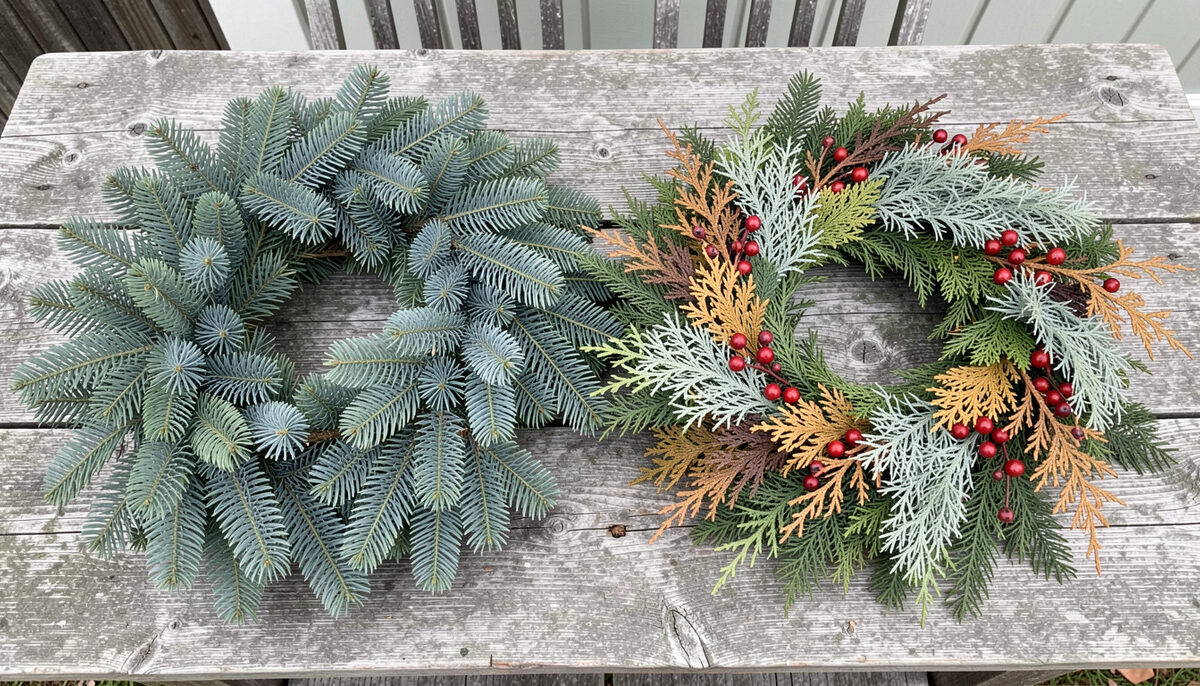
Two wreaths of the same size can look and behave very differently depending on which boughs went into them. The market offers two broad choices. A noble fir wreath uses one species. A mixed evergreen wreath blends several. Neither is simply better, but each suits a different door, budget and buyer, and the difference shows up in weight, scent, colour and how the wreath ages.
What noble fir is
Noble fir is a true fir native to the high country of the Oregon and Washington Cascades and the coastal ranges. It grows slowly, prefers cool summers and heavy rainfall, and produces a stiff branch with needles that sit flat and hold well. In the Christmas tree trade it is prized for colour, form and needle retention, and it commands a higher price than most alternatives. Its role in wreaths follows from the same qualities.
A noble fir wreath is dense, blue green and heavy for its size. It holds a clean round shape, sheds relatively little as it dries, and keeps its colour longer than many other boughs. The trade off is price and a certain formality: a noble fir wreath is a strong, simple statement, and it does not offer the varied texture that a mix provides.
What a mixed evergreen wreath is
A mixed wreath combines noble fir with other greens, most often cedar and berried juniper, and sometimes pine or boxwood. The idea is to borrow the strengths of each: fir for structure and needle retention, cedar for a soft drape and a strong scent, juniper for colour and berries. The result is a wreath with more depth and a more natural, gathered look.
Mixing is also a cost decision. Cedar and juniper are generally cheaper than noble fir, so a mixed wreath can be sold at a lower price for the same diameter. For a maker, the mix allows a lighter wreath that ships more cheaply and reads well in a photograph. For a buyer, it offers more visual interest for the money, at the cost of a slightly shorter useful life in some blends.
Colour, scent and weight
Colour is the first difference a buyer sees. Noble fir is a cool blue green with a fine, even texture. Cedar brings a warmer, darker green with a soft, feathery edge. Juniper adds a grey green with small blue berries that hold colour well into winter. A mixed wreath therefore looks less uniform and more like a piece gathered from a hedgerow.
Scent differs too. Cedar is the loudest of the three, with a resinous smell that fills an entryway. Noble fir is quieter but still fresh when the wreath is new. Weight follows the boughs: a noble fir wreath is heavier for the same diameter because the branch is denser and the needles sit closer. On a large wreath this matters to anyone who has to hang it on a door that swings.
How each ages
All fresh wreaths dry. The question is how gracefully. Noble fir is chosen partly because it holds its needles well as it dries, so a noble fir wreath tends to stay tidy even as it loses moisture. Cedar dries to a softer, duller look and can shed more. Juniper holds colour but loses its berries if it is knocked. A mixed wreath therefore ages unevenly, which some buyers find natural and others find untidy.
Where a wreath hangs changes the outcome as much as the boughs do. Between a door and a storm door, in full sun, or above a heat vent, any fresh wreath dries faster. The care routine in how to hang and care for a fresh wreath applies to both kinds and does more for longevity than the choice of species in most homes.
Price and value
Noble fir costs more because it is slower to grow and scarcer on good sites. Oregon State University's Christmas tree programme notes that suitable noble fir ground is limited, which is one reason the species carries a premium. A pure noble fir wreath therefore sits at the top of the range for a given size. A mixed wreath usually sits below it, and a wreath made mainly of cedar or pine sits lower still.
Value is not the same as price. A smaller noble fir wreath can outlast a larger mixed one and look better in January, which changes the calculation for anyone who wants a wreath that survives the whole season. A large mixed wreath gives more coverage for less money, which suits a porch, a barn door or a fundraiser catalogue where the price point drives the sale. The guide on how to choose a fresh wreath sets out how to compare them at the stall.
Which to choose
Choose noble fir when the door is the main event, when the wreath must last into January, and when a clean, formal look is wanted. Choose a mixed wreath when texture and scent matter more than uniformity, when the budget is tighter, or when the wreath is one of several decorating a large space. Both are built the same way, so the making guide applies to either: see how a fresh evergreen wreath is made. To place either on a door correctly, read how to hang and care for a fresh wreath.
What about other species
Noble fir and mixed evergreen are the two broad choices, but other species appear in the market. Douglas fir is common and cheaper, with a softer needle and a lighter colour. Fraser fir, grown in the eastern United States, is a favourite for trees and is also used in wreaths, with good needle retention and a strong scent. Pine and spruce are cheaper again, and both shed more as they dry, which is why they are less common in wreaths that have to look good for weeks.
Boxwood and cedar are used for their texture rather than their structure, and both appear in mixed wreaths. The principle is the same in every case: the species sets the ceiling on needle retention, weight and price, and the maker's skill sets everything else.