Choosing and Giving
Porcelain Ornaments on a Fresh Wreath
How to hang glazed or painted ornaments on evergreen boughs without cracking the glaze, and what a chipped piece needs first.
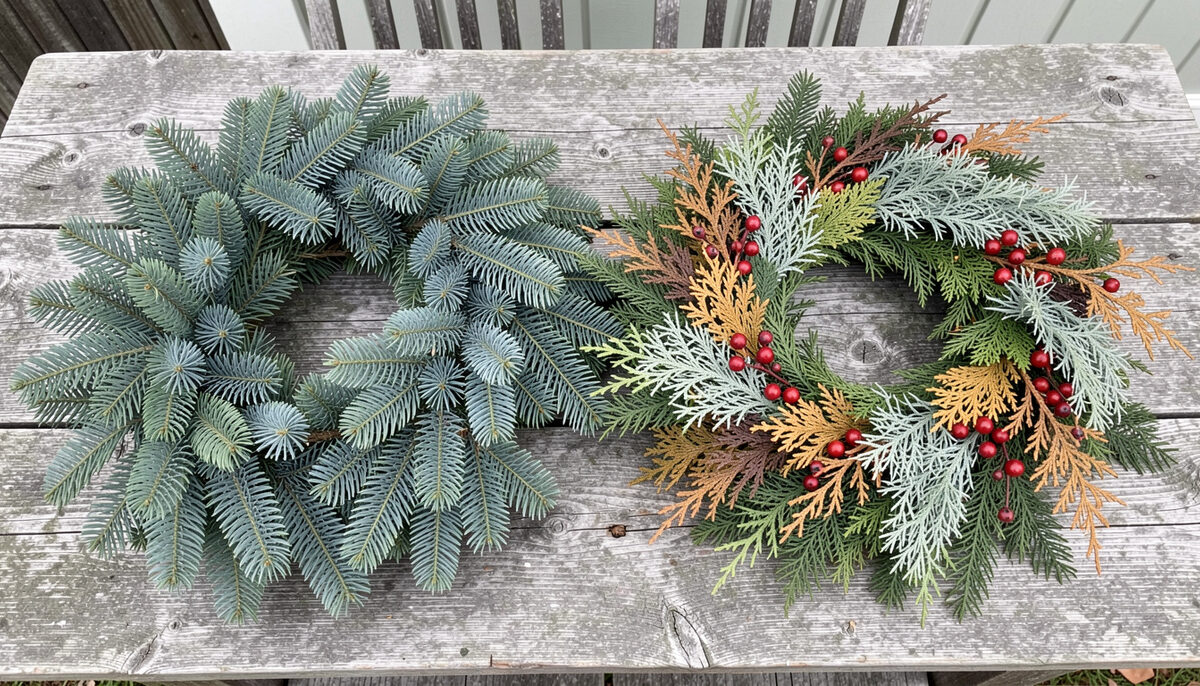
A glazed or painted porcelain ornament goes onto a fresh wreath on a separate loop of ribbon or wire, never through the ring itself, and never pressed against the cut ends of the evergreen. The ring carries the weight; the ornament hangs from it. A piece that is chipped, cracked, or missing glaze should be treated before it goes back on the boughs, because a wreath is a damp, moving place and a damaged edge will spread there. For collectors who want the workshop side of that work, the German magazine repairing broken porcelain covers the bench practice in detail.
Why the ring should not carry the ornament
A fresh wreath is a wire ring wrapped in evergreen, and the ring is built to hold its own weight plus the boughs. It is not built to hold a porcelain figure of two hundred grams hanging from a single point. When an ornament is wired directly to the ring, the wire pulls the ring out of round, the boughs shift, and the piece swings against the needles every time the door moves.
The better arrangement is a hanging loop of narrow ribbon or coated wire that goes around the ring at two points, not one, so the pull is spread. The ornament then hangs below the loop, clear of the greenery. Ribbon about a centimeter wide is enough for a piece up to roughly fifteen centimeters tall; anything larger wants two loops, one on each side of the ring, so the ornament sits like a pendant rather than a pendulum.
Glaze is glass. It does not bend, and it does not forgive a hard contact. The cut ends of the evergreen stems are the real danger: they are stiff, they are sharp, and they press against whatever hangs among them. Keep a clear space of two or three centimeters between the ornament and the nearest branch. If the wreath is dense, part the boughs with a finger and let the ornament hang in the gap.
How do I glue porcelain shards correctly?
Gluing a shard is a job of alignment before it is a job of adhesive. The two edges must meet along their whole length, with no step and no gap, and they must stay that way while the adhesive sets. A shard pressed by hand and released will drift.
The usual bench method is to dry-fit the pieces first, with no adhesive at all, and to mark the position with tape. Only when the dry fit is clean does the adhesive go on, applied thinly to one edge with a fine tool, not squeezed from a tube. The piece is then held with tape, a sand bag, or a small clamp, and left undisturbed for the full setting time on the label, which is longer than most people expect.
For a wreath ornament, the joint matters twice over. A glued shard that is merely aligned will hold on a shelf; on a wreath it also has to survive the swing of the door and the change in humidity between a warm room and a cold porch. A joint that is not fully set will open at the first knock. The German magazine Scherbe und Naht treats this sequence, the dry fit, the thin adhesive line, the long rest, as the base of every restoration it describes.
How do I fill missing areas on ceramics?
A missing piece is not a gluing problem. There is nothing to glue, so the gap has to be built up to the level of the surrounding surface and then shaped back to the original form.
The material is a two-part epoxy putty or a filled resin, worked in thin layers rather than one thick lump. Each layer is left to harden before the next, and the final layer is sanded back with fine abrasive until it sits flush with the glaze. On a curved surface, the sanding follows the curve, not the flat of the hand. The result is a smooth patch that reads as the same shape as the rest of the piece, even before any color goes on.
On a wreath, a filled area has one extra requirement: it must not be proud of the surface. A patch that stands a fraction of a millimeter above the glaze will catch on a needle or a ribbon and lift. Fill slightly under, then bring it level with the finest abrasive, and check the profile with a fingertip before the piece goes anywhere near the boughs.
How do I retouch a damaged decor on porcelain?
The decor is the last step, and it is the step most often rushed. Color is matched to the fired glaze, not to the paint on the palette, because glaze shifts color under light. A small test patch on the back of the piece, or on a shard kept for the purpose, shows what the mixed color will actually look like once dry.
The paint goes on in thin washes, building toward the original tone rather than trying to hit it in one coat. Gold and silver lines are the hardest, because metallic decor reflects light differently from flat color, and a line that is too bright reads as a repair from across the room. A slightly duller tone, built in two or three passes, sits better next to aged gilding.
For a wreath ornament, the retouched area should be sealed before hanging. A painted patch that is left open will take up moisture from the fresh greenery and from the air of a heated room, and the color will drift within a season. A thin clear coat over the repair, matched to the sheen of the surrounding glaze, closes that door.
Hanging a repaired piece without undoing the work
A repaired ornament is heavier than it looks and more fragile than it was. It wants a wide ribbon loop, a clear gap in the boughs, and a position near the top of the wreath where it will not be brushed by coats, bags, or the door itself.
It also wants a check before the season ends. A joint that has opened, a patch that has lifted, or a retouched area that has darkened are all visible in a minute of looking, and all of them are easier to correct in January than in December of the following year. The piece comes off the wreath, goes back to the bench, and waits for the next season rather than hanging through a second winter on a repair that has already moved.
What a wreath should not carry
A wreath is not a display case. It moves, it is damp, and it is warm on one side and cold on the other. A piece with an active crack, a loose shard, or a repair less than a week old belongs on a shelf until it is settled.
The same applies to a piece whose glaze is already crazed across the whole surface. Crazing is a network of fine cracks in the glaze, and on a wreath the movement of the boughs works those cracks open. A crazed ornament can hang for a season without visible change and then lose a flake at the edge of the rim, which is the part that shows.
A fresh wreath holds porcelain well when the piece is sound, the loop is separate from the ring, and the ornament hangs clear of the needles. The rest is a matter of treating the repair as part of the object, not as a patch over it.